
Kia Cee'd: Automatic climate control system / Automatic heating and air conditioning
The automatic climate control system is controlled by simply setting the desired temperature.
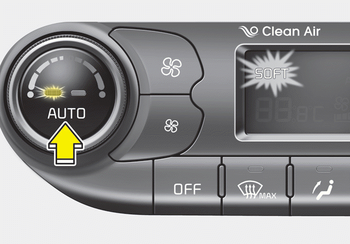
Soft mode
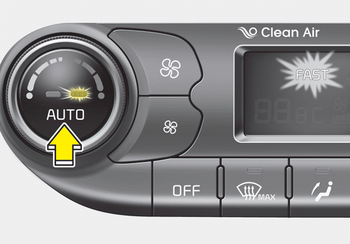
Fast mode
You can choose either the soft mode or fast mode to select the fan speed.
Soft mode : The wind blows gently.
Fast mode : The wind blows heavier than the soft mode to reach the selected temperature fast.
Each time you press the AUTO button, the mode will change as follows:
Soft mode ↔ Fast mode
The Full Automatic Temperature Control (FATC) system automatically controls the heating and cooling system as follows:
1. Press the AUTO button.
The modes, fan speeds, air intake and air-conditioning will be controlled automatically according to the temperature setting.
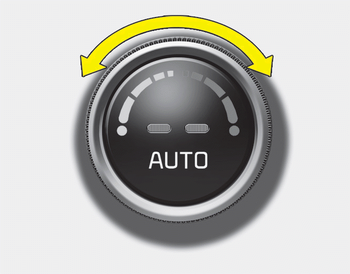
2. Turn the temperature control knob to set the desired temperature.
✽ NOTICE
- To turn the automatic operation off,
select any button of the following:
- Mode selection button
- Front windshield defrost button (Press the button one more time to deselect the front windshield defroster function. The 'AUTO' sign will illuminate on the information display once again.)
- Fan speed control button The selected function will be controlled manually while other functions operate automatically. - For your convenience and to improve the effectiveness of the climate control, use the AUTO button and set the temperature to 22°C/71°F (23°C/73°F -Except Europe).
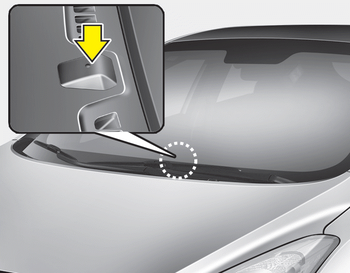
✽ NOTICE
Placing any object over the sensor on the instrument panel may interfere with the heating and cooling system.
 Automatic climate control system
1. Driver's temperature control knob
2. AUTO (automatic control) button
3. Fan speed control button (Higher speed)
4. Fan speed control button (Lower speed)
5. Climate control display
6. Air co ...
 Manual heating and air conditioning
The heating and cooling system can be
controlled manually by pressing buttons
or turning knob(s) other than the AUTO
button. In this case, the system works
sequentially according to the order ...
Other information:
Kia Cee'd JD Owners Manual: Type of warning indicator and sound
✽ NOTICE
The actual warning sound and indicator may differ from the
illustration according
to objects or sensor status.
Do not wash the vehicle's sensor with high pressure water.
When driving rearward(at “R’ shift), Side sensor operates and if
detecting some
object at the ...
Kia Cee'd JD Owners Manual: Child-protector rear door lock
(5 Door and wagon)
The child safety lock is provided to help
prevent children from accidentally opening
the rear doors from inside the vehicle.
The rear door safety locks should be used
whenever children are in the vehicle.
1. Open the rear door.
2. Insert a key (or screwdriver) into the
hole (1) and tur ...
