
Kia Cee'd: Cooling System / Water pump Repair procedures
Kia Cee'd JD Service Manual / Engine Mechanical System / Cooling System / Water pump Repair procedures
| Removal |
| 1. |
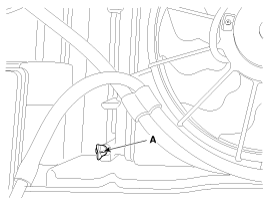
Loosen the drain plug (A), and drain the engine coolant. Remove the
radiator cap to drain with speed.
|

| 2. |
Remove the drive belt.
(Refer to Timing System - "Drive Belt")
|
| 3. |
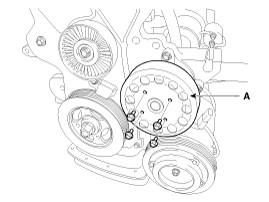
Remove the water pump pulley(A).
|
| 4. |
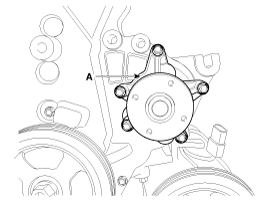
Remove the water pump(A).
|
| Inspection |
| 1. |
Check each part for cracks, damage or wear, and replace the coolant
pump assembly if necessary.
|
| 2. |
Check the bearing for damage, abnormal noise and sluggish rotation,
and replace the coolant pump assembly if necessary.
|
| 3. |
Check for coolant leakage. If coolant leaks from hole, the seal is defective.
Replace the coolant pump assembly and gasket.
|

| Installation |
| 1. |
Install the new gasket and water punp(A).
|
| 2. |
Install the water pump pulley.
|
| 3. |
Remove the drive belt.
(Refer to Timing System - "Drive Belt")
|
| 4. |
Fill with engine coolant.
|
| 5. |
Start engine and check for leaks.
|
| 6. |
Recheck engine coolant level.
|
 Water pump Components and components location
Components
1. Gasket
2. Water pump
3. Water pump pulley
...
 Water pump Troubleshooting
Troubleshooting
Symptoms
Possible Causes
Remedy
Coolant leakage
•
From the bleed ...
Other information:
: Tire Pressure Monitoring System – Troubleshooting
Tire Pressure Monitoring System – Warning Lamps
The low tire pressure warning
lamp has combined functions,
as it warns you when your tires
need air, and when the system is no longer
capable of functioning as intended.
Tire Pressure Monitoring System – Information Messages
...
: Using Lower Anchors and Tethers for Children
WARNING: Do not attach two child
safety restraints to the same anchor. In
a crash, one anchor may not be strong
enough to hold two child safety restraint
attachments and may break, causing
serious injury or death.
WARNING: Depending on where
you secure a child restraint, and
depending on the ...
© 2017-2026 www.kceed.com
