
Kia Cee'd: Rear Suspension System / Rear Lower Arm Repair procedures
Kia Cee'd JD Service Manual / Suspension System / Rear Suspension System / Rear Lower Arm Repair procedures
| Replacement |
| 1. |
Loosen the wheel nuts slightly.
Raise the vehicle, and make sure it is securely supported.
|
| 2. |
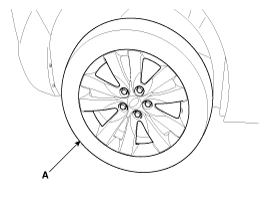
Remove the rear wheel and tire (A) from rear hub.
|

| 3. |
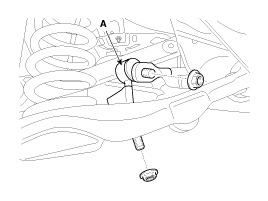
Loosen the nut and then remove the rear stabilizer link (A) from the
rear lower arm.
|
| 4. |
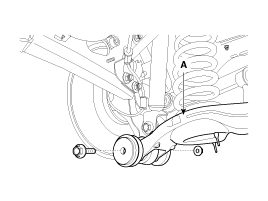
Loosen the bolt & nut and then remove the rear lower arm (A) from the
rear axle.
|
| 5. |
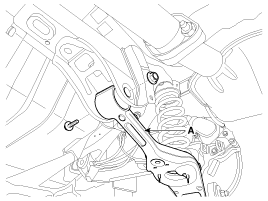
Loosen the bolt & nut and then remove the rear lower arm (A) from the
sub frame.
|
| 6. |
Install in the reverse order of removal.
|
| 7. |
Check the wheel alignment.
|
| Inspection |
| 1. |
Check the bushing for wear and deterioration.
|
| 2. |
Check the rear lower arm for deformation.
|
| 3. |
Check the coil spring and spring pad for deterioration and deformation.
|
| 4. |
Check for all bolts and nut.
|
 Rear Upper Arm Repair procedures
Replacement
1.
Loosen the wheel nuts slightly.
Raise the vehicle, and make sure it is securely supported.
2.
Remove the rear wh ...
 Rear Stabilizer Bar Repair procedures
Replacement
1.
Loosen the wheel nuts slightly.
Raise the vehicle, and make sure it is securely supported.
2.
Remove the rear wh ...
Other information:
Kia Cee'd JD Owners Manual: Adaptive Front Lighting System
(AFLS)
Adaptive front lighting system uses the
steering angle and vehicle speed, to
keep your field of vision wide by swiveling
and leveling the headlamp.
Change the switch to the AUTO position
when the engine is running. The adaptive
front lighting system will operate when
the headlamp is O ...
Kia Cee'd JD Service Manual: Water Jacket Insert Repair procedures
Remove and Installation
1.
Remove the cylinder head assembly.
(Refet to Cylinder Head Assembly - "Cylinder Head")
2.
Remove the water jacket Insert (A).
...
© 2017-2026 www.kceed.com
